
How to Stop Chasing Life
Productivity and self-help can't show you this.

I just need to catch up with life once. After that...
Barring a few, most of us just spend our time doing just that – Chasing life. Until we give up. Then the thought leans – could’ve… Until we collect ourselves and the chase restarts.
Chasing life so that we can live it our heart’s way is the most common human thought.
Constantly chasing something, life especially, is no easy thing. Often the faster we run after it, the further it gets. The tighter we hold on to it the quicker it slips through our fingers.
Then we seek help. Quotes, books, tools, talks. No wonder Self-help is an $80B a year industry.
We change our wallpapers to motivating quotes. Find examples from others’ lives that we hope can help us. We try writing tasks out. We try setting up reminders. Change what we believe are our key mistakes with good habits. We join yoga. We buy subscriptions to fancy motivational talks.
When we fail we swap one way for another blaming ourselves for picking up the wrong tool in the first place. Never realizing that there are fundamental issues with how we think about self-help and productivity that make them ineffective by default.
Turns out that Self-help / Productivity is also the world of placebos.
Then time changes. All is forgotten. Until the time changes once again. Then repeat.
And what about our dreams?
Big dreams that we all had for ourselves. Our plans about how we would make our mark in the world.
If you notice in the above write up, that part about dreams is missing. Because when mere survival seems difficult, the first thing to be given up is dreams.
In the real world dreams are about growth, imagination of our next level. Not just at work but in other areas of life. When we give them up we accept failure, at least temporarily.
The harsh truth – in this inescapable cycle for most of us, this temporary is the story of our lives.
It shouldn’t be. Life cannot be wasted away in this seemingly inescapable, cyclical misery.
So then how do we escape this cycle? Why can’t we seem to solve it? Are we doomed to living it?
No.
Our first step is to clearly understand the problem we face. And it is not a simple one.
The first reason – Dimensionality.
Modern life presents a weird dichotomous problem. On one criteria, by the day, it is a mad dash to nowhere. And at the exact same time, on a longer scale such as years, it is a slow moving, structural problem.
The second – Its ever-evolving nature.
We, our expectations, our environment and its expectation, our interaction with it, all keep evolving constantly. What works in one given moment will not work the next.
The third – How we see the problem.
Our view of the problem keeps changing. What was vexing you to no end one day, suddenly becomes an afterthought the next, because something else has changed in the larger picture.
The fourth – How our minds work.
They are remarkably adaptive and equally remarkably resistant to change. Anything forced will vanish the moment the pressure that enforces it reduces. The forced calm will shatter once your headphones come off.
A good solution to help fix any problem must at least match the scope of the problem. Modern life is a big one. What we need is a broad adaptive system that can keep pace with our life.
Simply put, to change our results, we need to change how we approach the change itself.
Here is what a good solution must do:
- Something that spans every aspect of our life, all the time. Something anchored deep enough within us to resist quick changes and evolutions while providing us steadiness in the surface churns.
- It needs to have a flexible reference frame to manage changes as they happen, discerning enough to know when they shouldn’t.
- It needs to be forgiving enough that when we err, we must be able to continue just where we left it. A skill that grows better with practice.
Turns out we have one such lever – Our Choices.
Look before you leap – your childhood knew this.
Here’s why choices are single best lever for change that we have.
When something changes or goes wrong, two things fix it for us.
Time — circumstances shift, burdens ease, familiarity develops, we adjust. But you have little control over when, how, or whether you go from the frying pan into the fire.
Or effort — you proactively seek solutions, you understand what needs to change, you plan and act. Here you have more control over timing and outcome. This is what we call a choice.
How do choices work?
All you have to do is assess and act. Simple enough in theory. Effective too. Well until life gets in the way.
In real life, choices arrive at their own time, irrespective of what else may be going on at the same time, carry consequences that ripple in many directions, and vary on dimensions most of us never consciously consider — nature, impact, scope, duration.
What makes them so important?
An average person makes over 1,000 of them every day. From which cereal to eat to decisions that shape loved ones for years.
We get some right. Miss the timing on others. Sometimes we’re so caught up fulfilling previous choices that new ones pass us by entirely.
Making choices is the single most consequential behavior we do. And we do it more than anything else.
The story of our life would be the story of our chances and our choices. What we got and how we responded. We cannot choose what happens to us. We can always choose how we respond.
So why don’t we treat them that way?
Most people unconsciously assign zero value to what doesn’t come with a cost tag. Choices included. This is exactly why they keep making them on autopilot.
Let’s make this concrete.
We use an imaginary values approach to do this. Not as a magic math exercise but to demonstrate in a simple way that treating choices as weightless is a big mistake.
We begin with assigning imaginary values to the choices you make each day.
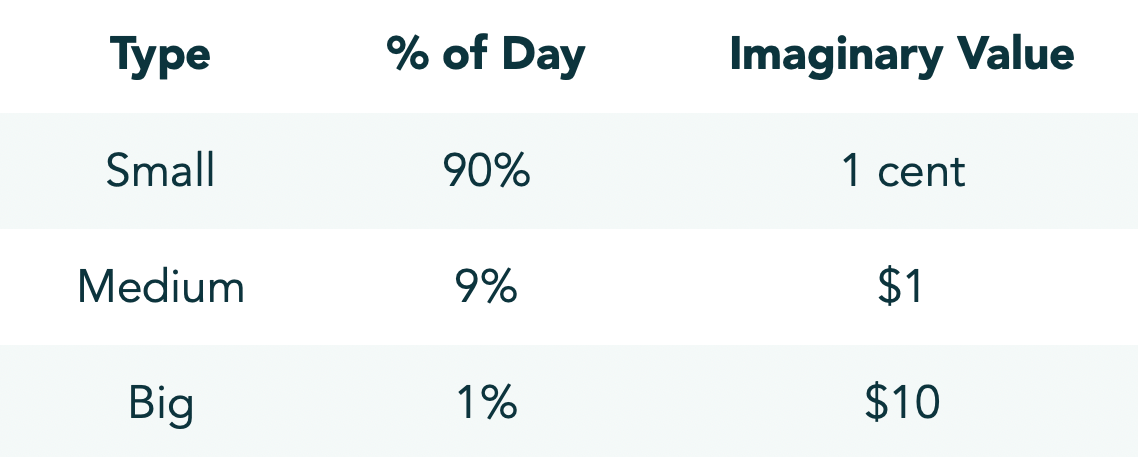
$7500 per year — the gain in Life Value you create if you make even 10 better choices daily.
Take it further.
Assume you made that gain. You start tomorrow at a higher baseline than today. Just like your investments do.
This is the beauty of choices. They become better with practice and build on each other, intended or not.
So how to put this in practice?
Once you realize that choices aren’t weightless, you begin to notice them. Noticing is where practice begins. Practice is where instinct builds.
There is no set formula to choose. No secret sauce to getting them right. Except developing the instinct with practice, slowing down and considering when the stakes really matter.
ClarityDo starts with helping you notice — before your day overflows with “yes, and that too.” It slows you down, just enough to know: why this, why now? Over time, it shows your deeper patterns. Every good choice you make betters your instincts. Then it helps you build it as a skill — better results, less wasted energy, more from each day.
Every choice you made before today built the ground you’re standing on. So will the choices you make from here. Yesterday should count. Tomorrow should be better for it.
This is how your dreams become reachable again – when your choices build in the direction you intend them to.
Getting better at choices is one of those fixes that reaches further than itself. Like exercise — you don’t just get fitter. The whole system responds. Your instincts sharpen. Your direction clarifies. Your capacity for the next decision grows from the last one.
Choices open the door. Now we walk the path.
That’s next.